
The history of Ongegund
The history behind Ongegund village goes back a long way – from the days of Paul Kruger and the Transvaal Republic through the era of Jan Smuts and DF ‘Danie’ Malan — two prime ministers born in the Riebeek valley.
In 1888 Edouard Lippert, a businessman from Hamburg, Germany, received permission from President Paul Kruger to build a cement factory near Pretoria. Lippert was quite a character. He financed gold mining at Barberton, won a diamond concession in Rhodesia, and obtained a monopoly for the manufacture of dynamite in the Transvaal in 1892.
’Eerste Cement Fabrieken Beperkt’ was registered in 1896 to operate the Lippert factory, which functioned until the South African War of 1899-1902 disrupted production. In 1902, production resumed under the name ‘The First Portland Cement Factory Limited’, and the name changed again in 1908 to the ‘Pretoria Portland Cement Company Limited (PPC)’ we know today.
In 1921 PPC part-founded the Cape Portland Cement Company, which built a factory at De Hoek near Piketberg – the fourth cement plant in South Africa. The plant expanded production rapidly, and had to look for raw materials elsewhere. The finest limestone deposits in the district were on the farm Ongegund, the birthplace of Jan Smuts, which PPC bought in 1946.
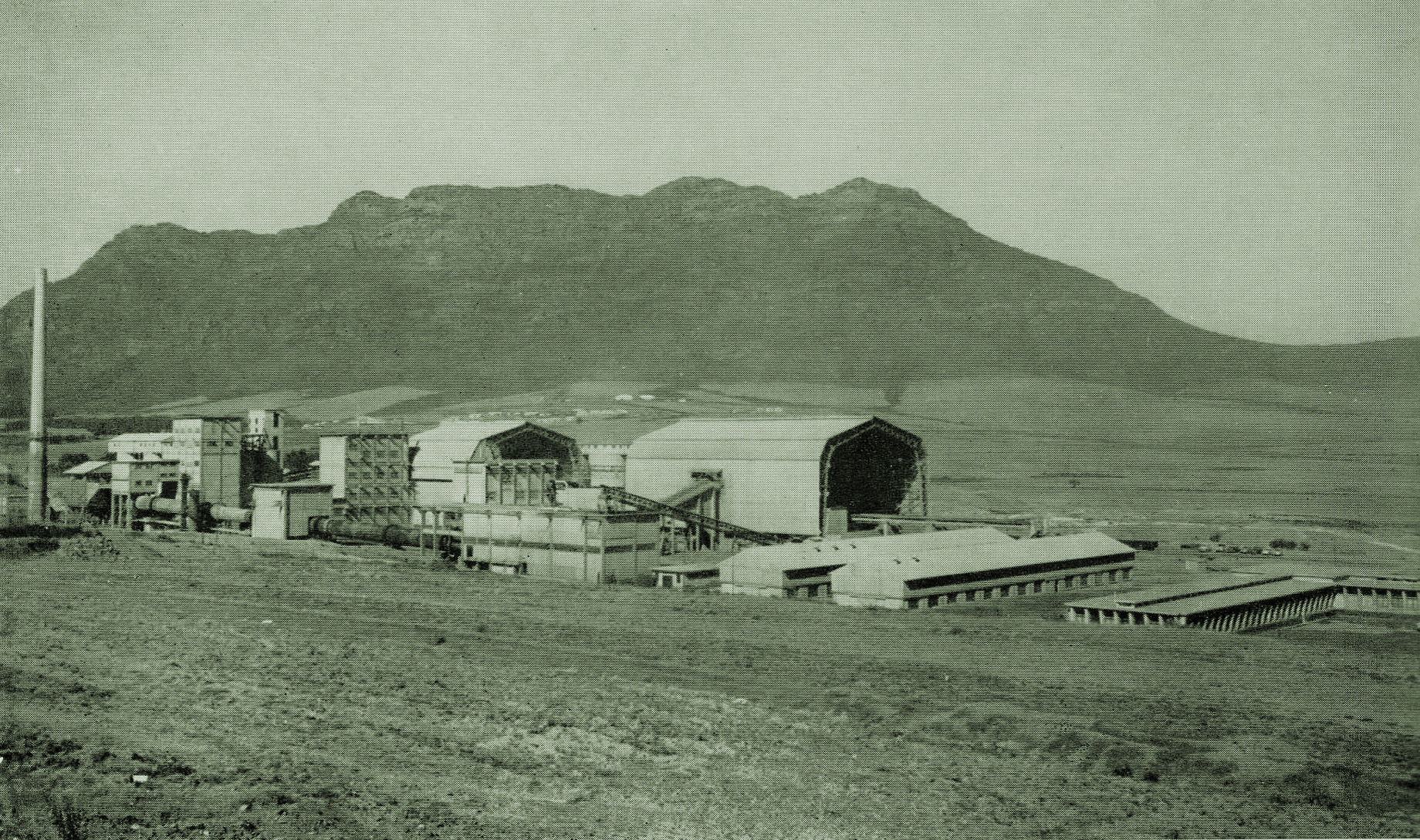
In July 1957 the Cape Portland Cement Company began construction of the Riebeek West plant, and the first kiln went into operation in January 1960. A second kiln, an advanced single-stage pre-heater kiln, was commissioned in 1968. Around the same time, the big English construction company Wimpey, which had built the plant, started construction of the Ongegund village, south of the Ongegund farm manager’s home – now erf 1565. PPC continued farming Ongegund – mostly with a dairy which supplied the residents – until 1984.
In 1975 Jan Smut’s birthplace, maintained by the Cape Portland Cement Company, was declared a national monument. In 1986 a two-year restoration process, overseen by renowned Cape architect Gawie Fagan, restored the homestead to its original condition.
In 1977, PPC assumed full ownership of the Cape Portland Cement Company, and the name fell away. That decade saw an expansion of the village by adding the Waboom Street houses and ‘Voëlvlei’, which apparently took the name from the district council water reservoirs fed by Voëlvlei dam.
By the end of the century, cement-manufacturing technology had become far more automated, and the workforce at Riebeek West shrank. As was fairly common corporate practice at the time, PPC decided it was no longer feasible for it to provide company housing, and in 2000 started the process of selling the houses to employees and transferring the private township to Swartland municipality.
This was a complicated process, as individual erven had to be surveyed, diagrammed and deeded. Also, the municipality would only agree to assuming responsibility if the residents undertook to manage the village’s extensive public spaces and playgrounds themselves. This required the formation of a homeowners’ association, which was to pay for the maintenance of the parks through levies.
In 2002, the first transfers of Ongegund properties took place, and in 2004 PPC auctioned off the former recreation centre, which became the Rugby Performance Centre in January 2005. The RPC closed in May 2017, and the property is now the St Monica’s shelter.
- See a map of Ongegund
- Read about Jan Smuts’s boyhood at Ongegund